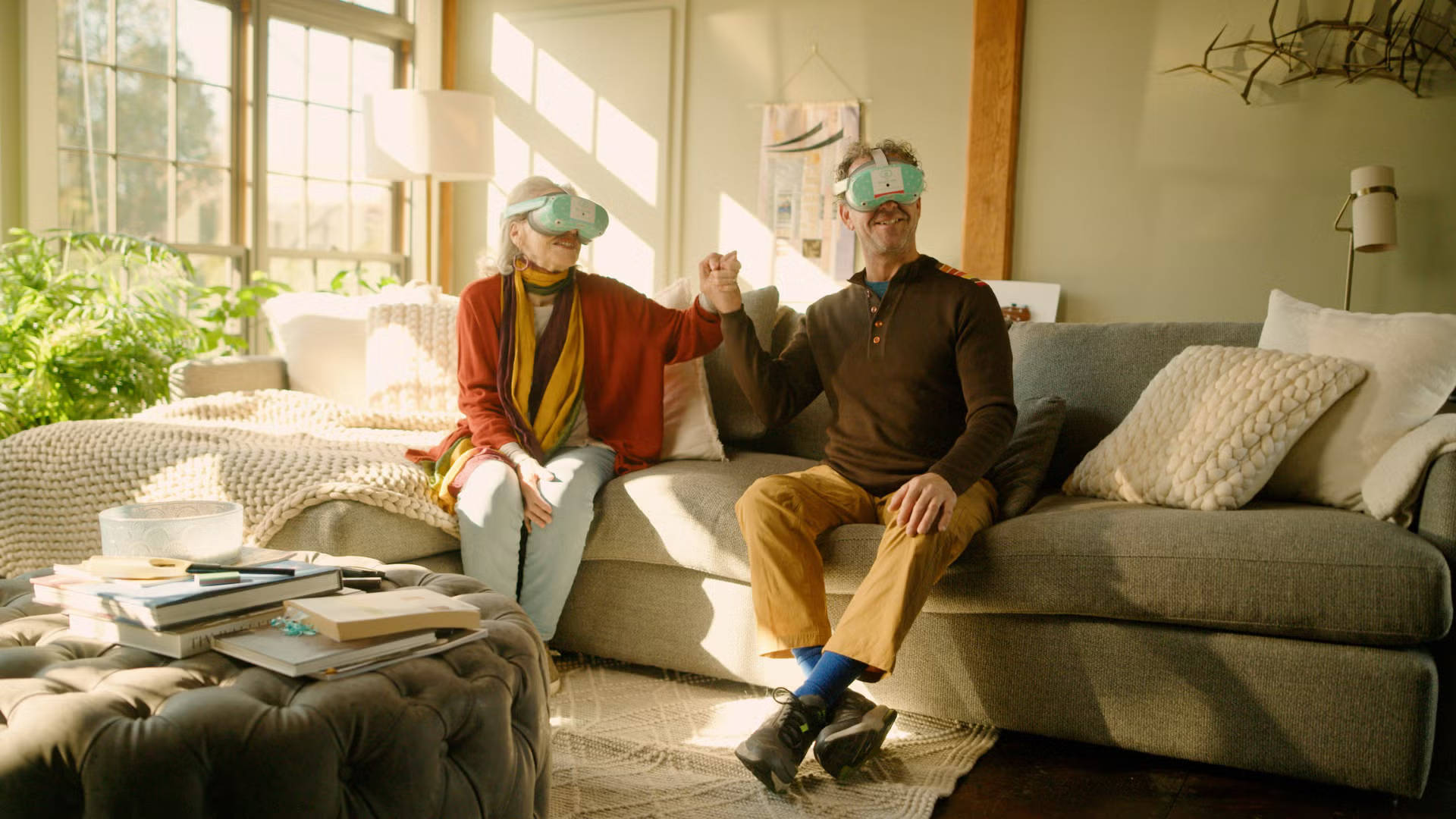
A new $3.8 million grant from the National Institutes of Health is helping UC Santa Barbara scholars reimagine how virtual reality can support older adults who are aging at home — and the family members and professionals who care for them.
“Our goal has always been to figure out how technology can help older adults thrive, despite cognitive and physical challenges,” said communication professor Tamara Afifi, who is co-leading the project with psychological and brain sciences professor Nancy Collins. “Virtual reality isn’t meant to replace relationships — it’s a tool for relationship maintenance and social bonding.”
The project builds on nearly a decade of work with Rendever, a VR company that designs lightweight, cord-free headsets and shared experiences specifically for older adults. Afifi’s team, which includes Rendever CEO Kyle Rand and Director of Research Jennifer Stamps, first piloted the technology at Maravilla, a senior living community near UCSB, in an early NIH-funded study focused on safety and feasibility for residents with dementia. Older adults with mild cognitive impairment or mild to moderate dementia at Maravilla used the VR remotely with a family member who was geographically separated. The results were promising: the system not only proved safe, but also improved residents’ quality of life and psychological and relational well-being.
That pilot laid the groundwork for a large clinical trial across eight countries and involving 186 pairs of participants: an older adult with mild cognitive impairment or mild to moderate dementia, and an adult child living at a distance. Dyads were randomly assigned to connect once a week for a month using either Zoom or Rendever’s shared VR platform, with follow-ups at one and three months.
Read the article in its entirety at The Current.