UC Santa Barbara’s Blum Center on Poverty, Inequality, and Democracy has been awarded a prestigious $100,000 grant from the California Environmental Justice Alliance (CEJA) which will enable it to continue its research and advocacy on behalf of the Central Coast’s most vulnerable populations.
As a multidisciplinary hub, the Blum Center has long focused on the intersection of economic hardship and systemic inequality. The CEJA grant will specifically bolster the Center’s Central Coast Regional Equity Initiative (CCREI), a project dedicated to documenting and dismantling the disparities in housing, health, and environmental risk that disproportionately affect multi-racial working-class communities in Santa Barbara, Ventura, and San Luis Obispo counties.
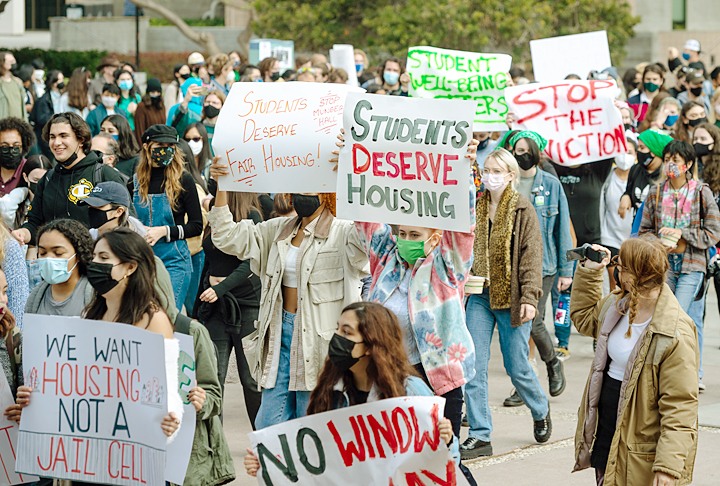
The CEJA grant arrives at a critical time as the Central Coast faces a skyrocketing cost of living, a quandary of particular significance for low-income and economically marginalized UCSB students. "It's deeply concerning that students come to UCSB to pursue their education and find themselves paying exorbitant rents for overcrowded, deteriorating housing,” said Kashia Arnold, the Blum Center’s assistant director. “When students are skipping meals to pay rent or living in units with mold and infestations, that's not just a housing problem, it’s an educational equity problem."
Over the past three years, our student-led Campus Housing Coalition has built something remarkable: a network of 15+ organizations working together to translate research into action,” said Gaye Johnson, an Associate Professor of Black Studies, who took over directorship of the Blum Center last year from Alice O’Connor, a longtime history professor. “From the People's Guide on UCSB’s Student Housing Crisis to supporting Isla Vista's first rental inspection program, we've shown that when students, researchers, and community partners come together, we can make real progress on housing justice."
According to the Blum Center’s research, the housing crisis isn't unique to UCSB but is a systemwide problem. Surveys show a significant number of UC students face housing insecurity, with a 2023 survey indicating 27% of UC students reporting this issue according to the Legislative Analyst’s Office. By examining successful and failed housing practices across UCs, the Blum Center hopes to identify which approaches work and advocate for preventative infrastructure investments instead of the current crisis management approach. From a policy standpoint, we anticipate that housing is a problem that no single campus can solve independently.
Indeed, nothing short of the educational equity of the UC system is at stake. According to a Blum Center voluntary student survey, 77.4% of UCSB student respondents considered their housing unaffordable, with 35.9% struggling to meet basic needs due to housing costs—a crisis that directly undermines educational access. Examining practices across the UCs reveals how housing has become a barrier to education, particularly affecting students of color and lower-income students and perpetuating inequality within public higher education.
At the core of the Center’s mission to solve these challenges is community-engaged research. “"At the Blum Center, we prioritize the needs of the communities we belong to,” said Arnold. “Our housing work reflects our commitment to research that doesn't just study problems from a distance but works alongside community members to create real solutions."
Story by Nicholas Schou